Backend for Frontend (BFF) Layer
The Backend for Frontend (BFF) pattern is an architectural approach that creates a dedicated backend service for every frontend application, such as web, mobile, or desktop. Instead of treating all clients the same way, the BFF layer functions as an intermediary between the frontend and the related services or APIs.
Each frontend in this pattern interacts with its own backend service, known as the BFF, which then interacts with any necessary internal services, databases, or third-party APIs. By separating concerns, this design ensures that changes to one frontend or its corresponding backend do not impact others.
BFF Architecture Overview
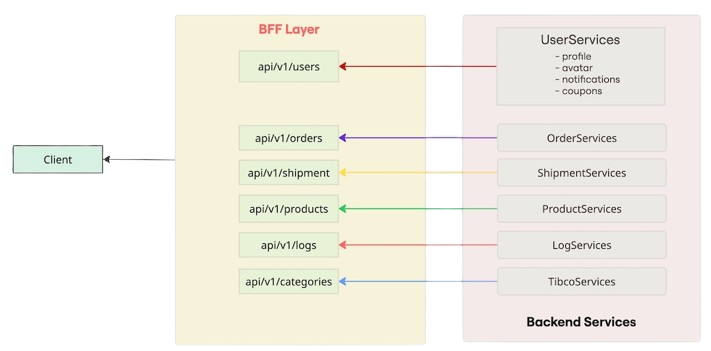
The BFF layer acts as an intermediary between clients and backend microservices, aggregating and transforming data to meet specific frontend requirements.
How BFF Works
Frontend Requests
Each frontend (e.g., web application, mobile application) communicates with its dedicated BFF service, creating a tailored communication channel that understands the specific needs and constraints of that platform.
BFF Responsibilities
The BFF layer collects data from several APIs or services, modifies or formats data to meet the specific needs of the frontend, and takes care of authentication, caching, and other backend processes.
Backend Services
Data can be fetched or processed by the BFF through communication with microservices, databases, or third-party APIs, abstracting the complexity from the frontend applications.
Example BFF Implementation with Node.js
The following code demonstrates how a BFF layer can aggregate data from multiple backend services and transform it into a customized response for the frontend application.
BFF Data Aggregation Example
app.get('/api/v1/user', async (req, res) => {
    const token = req.headers.authorization;

    try {
        // Fetch user profile
        const profilePromise = axios.get('https://api.domain.com/user/profile', {
            headers: { Authorization: token }
        });

        // Fetch user avatar
        const avatarPromise = axios.get('https://api.domain.com/user/avatar', {
            headers: { Authorization: token }
        });

        // Fetch user notifications
        const notificationsPromise = axios.get('https://api.domain.com/user/notifications', {
            headers: { Authorization: token }
        });

        // Wait for all requests to complete
        const [profile, avatar, notifications] = await Promise.all([
            profilePromise,
            avatarPromise,
            notificationsPromise
        ]);

        // Aggregate and transform data for frontend
        res.json({
            profile: profile.data,
            avatar: avatar.data.url,
            notifications: notifications.data.items
        });
    } catch (error) {
        res.status(500).json({
            error: 'Failed to fetch user data'
        });
    }
});
When to Use BFF
The BFF pattern is particularly valuable in specific scenarios where traditional API approaches fall short. Here are the key use cases where implementing a BFF layer provides significant benefits.
Multiple Frontends
When managing different frontends (web, mobile, desktop) with unique requirements for APIs, authentication, and data formatting. The BFF layer ensures each frontend receives optimized data and functionality tailored to its specific needs.
Complex Data Aggregation
When your frontend needs data from multiple backend services combined into a single response. The BFF simplifies this by collecting information from various sources and delivering it efficiently to the frontend.
Custom Data Transformation
When backend data needs to be modified and shaped differently for each frontend. This ensures optimal data structure and reduces frontend processing overhead.
Performance Optimization
When you need to reduce the number of network requests from the client. The BFF aggregates multiple API calls into single responses, improving load times and user experience.
Centralized Security
When you want to centralize authentication and authorization logic. The BFF ensures consistent security practices across all frontends while reducing security vulnerabilities.
Microservices Architecture
When working with microservices and wanting to provide a unified API for different frontends. The BFF aggregates data from multiple microservices while maintaining separation of concerns.
Benefits of BFF Architecture
Advantages
- Frontend-Specific Logic: Each BFF is tailored to the specific needs of its frontend, reducing unnecessary complexity
- Improved Performance: Aggregates data from multiple services into single responses, reducing network requests
- Simplified Development: Frontend teams focus on UI/UX without backend complexities
- Decoupling: Independent development and deployment of frontend and backend layers
- Flexibility: Different frontends can have their own BFFs and evolve independently
- Centralized Security: Consistent authentication and authorization practices across frontends
- Efficient Caching: Improved performance and reduced load on backend services
- Node.js Compatibility: Well-suited for non-blocking, event-driven architecture
Considerations
- Increased Complexity: Additional component in architecture increases system complexity
- Maintenance Overhead: More services to maintain and deploy independently
- Development Effort: Requires additional development and maintenance resources
- Code Duplication: Common logic may be duplicated across multiple BFFs
- Potential Latency: Additional layer can introduce latency if not optimized
- Scalability Challenges: Each BFF must be scaled independently
- Service Dependencies: Performance depends on underlying backend service reliability
Implementation Best Practices
Keep BFFs Lightweight
Focus on data aggregation and transformation rather than business logic. Keep the BFF layer thin to maintain performance and avoid complexity.
Team Ownership
Have frontend teams own their respective BFF services to ensure alignment between frontend needs and BFF capabilities.
Monitor Performance
Implement comprehensive monitoring and logging to track BFF performance, error rates, and resource utilization.
Version Management
Implement proper API versioning strategies to support multiple frontend versions and ensure smooth migrations.
Conclusion
The Backend for Frontend (BFF) pattern is a strategic solution for modern applications with multiple frontends, offering tailored APIs, improved performance, and greater flexibility. While it introduces additional complexity and maintenance overhead, the benefits of decoupling, optimized data delivery, and centralized logic make it a valuable architectural choice.
Leveraging technologies like Node.js for BFF implementation enables efficient data aggregation and transformation, ensuring each frontend receives the best possible experience. By adopting the BFF approach, development teams can streamline workflows, enhance security, and support the independent evolution of their applications.
Key Takeaways
- BFF creates dedicated backend services for each frontend platform
- Ideal for applications with multiple frontend types (web, mobile, desktop)
- Improves performance through data aggregation and reduced network calls
- Enables independent frontend development and deployment
- Requires careful consideration of complexity vs. benefits trade-offs